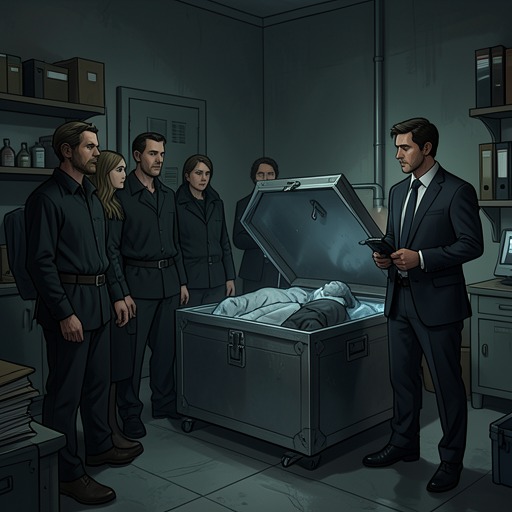
human stasis pods
The Vampire Prince’s BrideHuman stasis pods are the preservation chambers holding hundreds of humans in suspended sleep aboard an ancient cargo ship. They are not merely storage technology: they make the rescue of an endangered population materially possible while also concealing the boundary between survival and death. Tom’s mission depends on recovering the ship intact, and the pods therefore become the central physical condition of a planned human sanctuary.
Definition and Physical Appearance
Human stasis pods are arranged throughout the cargo ship in a long, unusually wide corridor. Their operation prevents ordinary decomposition, allowing bodies to remain preserved while the vessel travels through space. The ship itself is moving at light speed by an outdated standard, so slowly that its sensors scarcely register it as a ship; its age is impossible to determine because the few artifacts recovered from Earth are too ancient to date. The pods consequently belong to a technological system whose history has been obscured along with the history of the humans inside it.
Tom sees the nearest occupant as a female human with closed eyes, overgrown and matted hair, and skin the same hue as his mother’s. The scene makes the pods visually legible as both machines and enclosures: the sleepers are recognizable as people, yet their stillness and confinement make them resemble cargo. A dim blue glow shines from the pods along the corridor, while the crystalline, sharply angled structure around them resembles stained glass. The cold is severe enough for Tom’s breath to crystallize, and the surrounding silence is intensified by the sleeping faces on every side.
Role in Tom’s Rescue Mission
Tom tells Sara that he is on a mission to retrieve a ship filled with humans in stasis. His assignment is to bring the sleepers to a planet where they can be awakened and establish a human sanctuary. The pods thus connect a military or interstellar recovery operation to a long-term political project: the objective is not simply to seize a vessel, but to preserve a population until it can become the foundation of a new colony.
Tom needs Sara because she is a Corps officer who can help him pass security checkpoints. Her participation is therefore operationally important, but the pods also change the emotional and ethical meaning of their partnership. Once Sara understands that the ship contains human beings rather than ordinary freight, the mission becomes a question of rescuing people whose future depends on the two of them getting through the ship and returning it safely.
The Cargo Ship and the Uncertain Living
Reconnaissance estimates indicate that the ship contains at least six hundred humans. Tom and Sara will have to count the survivors after reaching the sanctuary, because the pods preserve bodies without revealing whether those bodies are still alive. The technology suspends the visible consequences of death as effectively as it suspends aging or decay. A pod can therefore promise preservation while withholding confirmation of life.
That uncertainty is one of the pods’ most disturbing features. Tom recognizes that some of the occupants may already be dead, but decomposition would not occur inside the stasis chambers, so there is no way to know who survived until the pods are opened. The ship is consequently a mass archive of unresolved human fates. Its apparent stillness does not mean safety; it means that the decisive judgment has been deferred.
Sara asks whether the humans were taken by the same people who abducted her from Earth. Tom cannot prove it, but he observes that the technology of the ships in which humans have been found appears similar. The pods therefore function as material evidence in a wider history of abduction. Their design links Sara’s personal displacement to the fate of a population and suggests a recurring system rather than an isolated crime. Tom speculates that the humans may have been intended for slave labor or even consumption, leaving the pods suspended between rescue infrastructure and the remains of an exploitation network.
Installation, Danger, and Consequences
The ship cannot simply be detached and towed. Tom explains that twelve anchors must be placed at strategic points so the cargo vessel can be dragged back without being torn apart. The pods make structural preservation essential: damaging the ship could damage the chambers and destroy the very people the mission seeks to save. Tom and Sara work quickly and silently through the corridor, planting the anchors while the blue-lit sleepers remain around them.
The operation changes from recovery to immediate danger when footsteps echo through the corridor as Tom plants the fourth anchor. Both rescuers hide behind the pods, using the chambers that contain the vulnerable humans as cover from whoever has arrived. A voice announces that there has been movement. In that moment, the pods become part of the tactical geography of the rescue: they shelter Tom and Sara, but their presence also makes concealment hazardous, because any disturbance near the sleepers may expose the mission or endanger the occupants.
The pods’ ultimate consequence remains conditional on the rescue’s success. If Tom and Sara secure the vessel, at least six hundred preserved humans may be transported to a sanctuary and awakened for colonization. If the operation fails, the same chambers may remain sealed, with the living and the dead indistinguishable inside an abandoned or contested ship. Their significance lies in this suspended future: the pods preserve possibility, but they cannot guarantee liberation, survival, or a return to humanity’s lost home.